Posts

Showing posts with the label AI

Understanding Agentic AI: The Future of Autonomous Intelligence

  Artificial Intelligence (AI) is evolving rapidly, and one of the most intriguing advancements in this field is   Agentic AI . Unlike traditional AI models that passively process inputs to generate outputs, agentic AI operates autonomously, making decisions, setting goals, and interacting dynamically with its environment. But what exactly does this mean, and why does it matter? Let's explore. What is Agentic AI? Agentic AI refers to AI systems that exhibit autonomy, proactiveness, and decision-making capabilities. These systems go beyond simple automation by reasoning about their objectives, adjusting their actions based on feedback, and even seeking new information to accomplish their tasks effectively. At its core, an agentic AI system typically possesses: Autonomy : The ability to operate without constant human supervision. Proactivity : The capacity to set goals and take initiative rather than just responding to prompts. Adaptability : The skill to learn from interactions...
How AI Integration with RPA Enhances Automation and Expands Its Scope

 In today’s fast-evolving digital landscape, businesses are continuously exploring innovative solutions to enhance operational efficiency and optimize workflows. Robotic Process Automation (RPA) has already established itself as a cornerstone of digital transformation, offering a way to automate repetitive and rule-based tasks. However, when coupled with Artificial Intelligence (AI), RPA evolves into a more powerful and robust solution, enabling organizations to tackle complex tasks and significantly broaden the scope of automation. This blog delves into how AI integration with RPA enhances its capabilities and explores the specific features of RPA that get a substantial boost. How AI Enhances RPA Solutions 1. Intelligent Decision-Making Traditional RPA excels at executing tasks based on predefined rules. However, it struggles when faced with unstructured data or decision-making scenarios that require contextual understanding. AI bridges this gap by empowering RPA bots to make data...

Understanding Regression Models in Data Science: Usage and Importance

 Regression models are a cornerstone of data science and machine learning, used extensively to understand relationships between variables and make predictions. Whether you're predicting housing prices, estimating sales, or analyzing trends, regression models provide the foundation for numerous applications. In this blog post, we'll explore various types of regression models, their use cases, and why they are important in the field of data science. What is Regression? Regression is a statistical method used to determine the relationship between a dependent variable (the outcome) and one or more independent variables (the predictors). The goal of regression is to model this relationship to make predictions or understand the underlying patterns in the data. Types of Regression Models and Their Use Cases 1. Linear Regression Linear regression is the simplest and most widely used regression model. It assumes a linear relationship between the dependent variable and the independent va...

Handling Missing Data in Machine Learning: Python Tools You Need to Know

Image
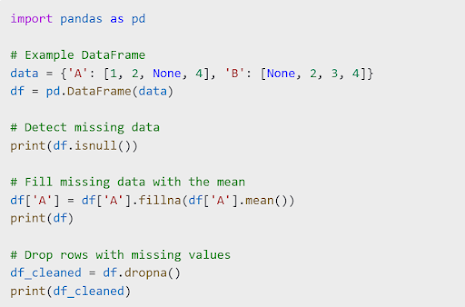
Missing data is a common problem in machine learning projects. Whether it's due to data collection errors, incomplete surveys, or missing sensor readings, dealing with incomplete datasets is essential to ensure your models perform reliably. Thankfully, Python offers a suite of tools and libraries to handle missing data effectively. In this blog, we'll explore some of the most popular Python tools and techniques for fixing missing data in datasets for machine learning. 1. Pandas Pandas is one of the most widely used Python libraries for data manipulation and analysis. It provides powerful tools for detecting and handling missing data: Features: Detecting Missing Data : isna() or isnull() : Identifies missing values in a DataFrame or Series. notna() or notnull() : Identifies non-missing values. Handling Missing Data : fillna() : Fills missing values with a specified value or method (e.g., forward-fill or backward-fill). dropna() : Removes rows or columns with missing values. in...