Posts

Smoke Testing vs Sanity Testing: A Detailed Comparison

 In the world of software testing, Smoke Testing and Sanity Testing are often discussed together due to their overlapping objectives. However, they serve distinct purposes and are used in different scenarios. This blog will explore their purpose, scope, execution, similarities, and differences, providing clarity on when to perform and use these testing types. What is Smoke Testing? Purpose Smoke Testing, also known as "Build Verification Testing," ensures that the critical functionalities of the software are working correctly after a new build is deployed. It acts as a preliminary check to decide whether the software is stable enough for further testing. Scope Focuses on the core features of the application. Verifies the stability of the build. Involves only high-level testing without delving into detailed scenarios. Execution Performed by developers or testers. Test cases are predefined and include the critical paths of the application. Automated tools or manual execution ...

Understanding Regression Models in Data Science: Usage and Importance

 Regression models are a cornerstone of data science and machine learning, used extensively to understand relationships between variables and make predictions. Whether you're predicting housing prices, estimating sales, or analyzing trends, regression models provide the foundation for numerous applications. In this blog post, we'll explore various types of regression models, their use cases, and why they are important in the field of data science. What is Regression? Regression is a statistical method used to determine the relationship between a dependent variable (the outcome) and one or more independent variables (the predictors). The goal of regression is to model this relationship to make predictions or understand the underlying patterns in the data. Types of Regression Models and Their Use Cases 1. Linear Regression Linear regression is the simplest and most widely used regression model. It assumes a linear relationship between the dependent variable and the independent va...

How to Test API/flow which are dependent on External API response using SOAPUI

Image
  Mocks are required in testing when you want to simulate the behavior of complex, external, or uncontrollable components in your system. They are particularly useful for isolating the unit of code under test and for verifying interactions with dependencies.  In this article, we will see how to Mocking REST APIs Using SoapUI. It is an open-source API Testing tool used for both  Simple Object Access Protocol (SOAP)  and  Representational state transfers (REST)  services. It is widely used in enterprise applications for the development, mocking, simulation, and testing of web services. This article provides a step-by-step guideline on how to create a REST Mock Service using SoapUI. Now let’s see the step below. Stepwise Implementation  Step 1:   Create a new REST project by clicking on  REST  present on the Toolbar. Create REST Project Using SOAP UI Step 2:  Specify the URL for the restful Mock service you want to create. Specify Name...

Efficient Ways of Handling Excel with Blue Prism

  Excel is one of the most commonly used tools in businesses for data management, analysis, and reporting. Automating Excel processes with Blue Prism, a leading Robotic Process Automation (RPA) platform, can save significant time and reduce errors. However, working with Excel in Blue Prism can also present challenges. Here, we explore efficient ways to handle Excel in Blue Prism and the associated challenges, along with potential solutions. 1. Using Built-in Blue Prism VBO (Visual Business Object) Blue Prism provides a pre-built VBO for Excel, which contains a set of actions for interacting with Excel files. These actions include opening workbooks, reading and writing data, applying formulas, and saving files. Advantages: Easy to implement without custom scripting. Suitable for basic Excel automation tasks. Challenges: Limited flexibility for advanced operations such as handling pivot tables or charts. Performance issues with large Excel files. Solutions: Break larg...

Orchestration and Control in Multi-Bot RPA Architecture: Challenges and Design Considerations

  In Robotic Process Automation (RPA), orchestrating and controlling multiple bots is critical to ensuring efficiency, accuracy, and scalability. A well-designed orchestration framework aligns bot operations with business objectives while minimizing errors and redundancies. This article focuses exclusively on the design of orchestration and control in a multi-bot architecture and explores the challenges involved. Key Elements of Orchestration and Control Centralized Orchestration: A centralized control system, often provided by the RPA platform, coordinates bot activities, monitors performance, and resolves exceptions. Workload Management: Efficiently distributing tasks among bots based on their capacity and priority. Bot Collaboration: Enabling bots to communicate effectively in scenarios where tasks are sequential or interdependent. Event Coordination: Assigning specific bots to trigger or handle certain events, such as notifications or data updates. Design Consider...

Test Automation: What is ADA Testing?

  ADA testing refers to the process of evaluating and ensuring that websites, applications, and digital content are accessible to people with disabilities, in accordance with the Americans with Disabilities Act (ADA). The ADA is a U.S. law that prohibits discrimination against individuals with disabilities and mandates equal access to services, including digital platforms. Importance of ADA Testing : Legal Compliance : Many organizations are required to comply with ADA standards. Failure to do so can lead to legal consequences, including lawsuits or fines. Inclusivity : ADA testing ensures that people with disabilities, including those with visual, auditory, or motor impairments, can use websites and applications. This supports greater inclusivity and allows more people to access and benefit from digital content. Wider Audience Reach : Making websites accessible increases the potential user base by accommodating individuals with different disabilities. This can have positive busin...

Handling Missing Data in Machine Learning: Python Tools You Need to Know

Image
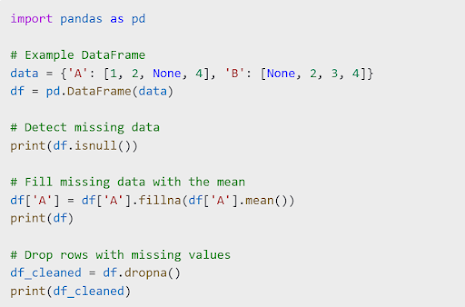
Missing data is a common problem in machine learning projects. Whether it's due to data collection errors, incomplete surveys, or missing sensor readings, dealing with incomplete datasets is essential to ensure your models perform reliably. Thankfully, Python offers a suite of tools and libraries to handle missing data effectively. In this blog, we'll explore some of the most popular Python tools and techniques for fixing missing data in datasets for machine learning. 1. Pandas Pandas is one of the most widely used Python libraries for data manipulation and analysis. It provides powerful tools for detecting and handling missing data: Features: Detecting Missing Data : isna() or isnull() : Identifies missing values in a DataFrame or Series. notna() or notnull() : Identifies non-missing values. Handling Missing Data : fillna() : Fills missing values with a specified value or method (e.g., forward-fill or backward-fill). dropna() : Removes rows or columns with missing values. in...